Waging Peace by David Hartsough
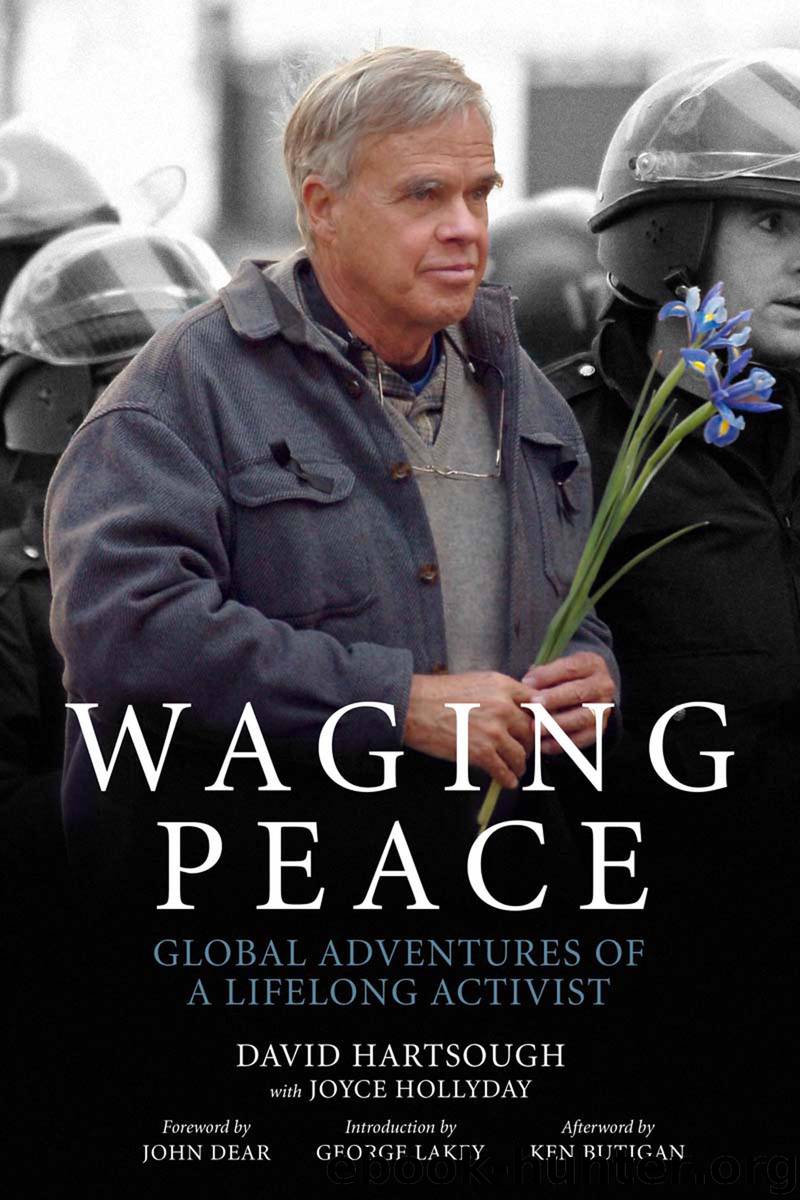
Author:David Hartsough
Language: eng
Format: epub
ISBN: 9781629630519
Publisher: PM Press
Published: 2014-04-25T16:00:00+00:00
Guatemalan refugees on the Chiapas border in Mexico, having fled their homes and the genocidal violence in Guatemala (1982). [Photo: David Hartsough]
A generation later, the cycle of repression was repeating itself. In the decade before I visited, more than 160,000 people had been murdered. An additional estimated 40,000 had been “disappeared” when armed soldiers or death squads seized them out of their homes, off the streets, or from places of work, never to be seen again. Four hundred indigenous villages had been wiped off the map. The bodies were piling up in ravines, dumped on roadsides, and buried in mass graves, and the Guatemalan people were traumatized by fear and terror.
I had first seen evidence of the horror in December 1982, when I visited Chiapas, on Mexico’s border with Guatemala. Thousands of refugees, carrying their children and whatever else they could on their backs, were streaming into Chiapas from Guatemala after their homes had been destroyed and their villages burned down. One group had received a visit from survivors of a massacre in a neighboring village, who carried the news, “You are next.”
The villagers fled at night, knowing that if they were detected, they would be killed. They lived in huts hastily constructed in the dense, rainy jungle out of palm leaves and bark from banana trees. Small fires sputtered, started by the refugees in a near-futile effort to keep warm and cook a little food. No refugee agencies came to their aid.
In Guatemala in 1985, our delegation met with members of the Grupo de Apoyo Mutuo (Group for Mutual Support of the Families of the Disappeared). The group, also known by its acronym GAM, had been founded in June 1984 by Montenegro de García, a fifth-grade teacher and mother of a one-year-old. After her husband was “disappeared”—and her visits to hospitals and morgues and government offices revealed no trace of him—García met other women suffering the same loss and organized a memorial mass for their loved ones. She formed the GAM to help families give one another support in their time of sorrow and distress, and to press the government for the return of their loved ones alive.
Families of more than five hundred of the disappeared had joined. One family I met had suffered the disappearance of nineteen of its members—daughters, sons, grandparents, brothers, sisters, aunts, uncles, cousins. Only a nineteen-year-old sister, a four-year-old brother, and an eighty-year-old grandmother were still alive. Their grief, and that of the thousands of other families of the disappeared, was overwhelming.
Members of the Grupo had petitioned government officials, taken out ads in newspapers, held weekly nonviolent demonstrations for months, and even talked with Guatemala’s president, pleading for the return of their loved ones. In mid-March of 1985, while we were there, President Oscar Humberto Mejía Victores went on national television and denounced the Grupo as “terrorists” and “communists” who were being used by “international subversives.” In Guatemala, that was an invitation to the military and the death squads to begin their work.
At the
Download
This site does not store any files on its server. We only index and link to content provided by other sites. Please contact the content providers to delete copyright contents if any and email us, we'll remove relevant links or contents immediately.
The Secret History by Donna Tartt(19025)
The Social Justice Warrior Handbook by Lisa De Pasquale(12182)
Thirteen Reasons Why by Jay Asher(8883)
This Is How You Lose Her by Junot Diaz(6869)
Weapons of Math Destruction by Cathy O'Neil(6260)
Zero to One by Peter Thiel(5782)
Beartown by Fredrik Backman(5733)
The Myth of the Strong Leader by Archie Brown(5491)
The Fire Next Time by James Baldwin(5422)
How Democracies Die by Steven Levitsky & Daniel Ziblatt(5210)
Promise Me, Dad by Joe Biden(5139)
Stone's Rules by Roger Stone(5078)
A Higher Loyalty: Truth, Lies, and Leadership by James Comey(4946)
100 Deadly Skills by Clint Emerson(4911)
Rise and Kill First by Ronen Bergman(4775)
Secrecy World by Jake Bernstein(4737)
The David Icke Guide to the Global Conspiracy (and how to end it) by David Icke(4696)
The Farm by Tom Rob Smith(4500)
The Doomsday Machine by Daniel Ellsberg(4480)
